
A Complete Guide to Microsoft Windows Server, Windows Server Datacenter, SQL Server, Perpetual Licensing, Subscription Licensing, Pricing, and Cost Savings
Organizations today face a critical decision when purchasing Microsoft infrastructure software: should they invest in traditional perpetual licenses, subscription-based server licensing, or a combination of both?
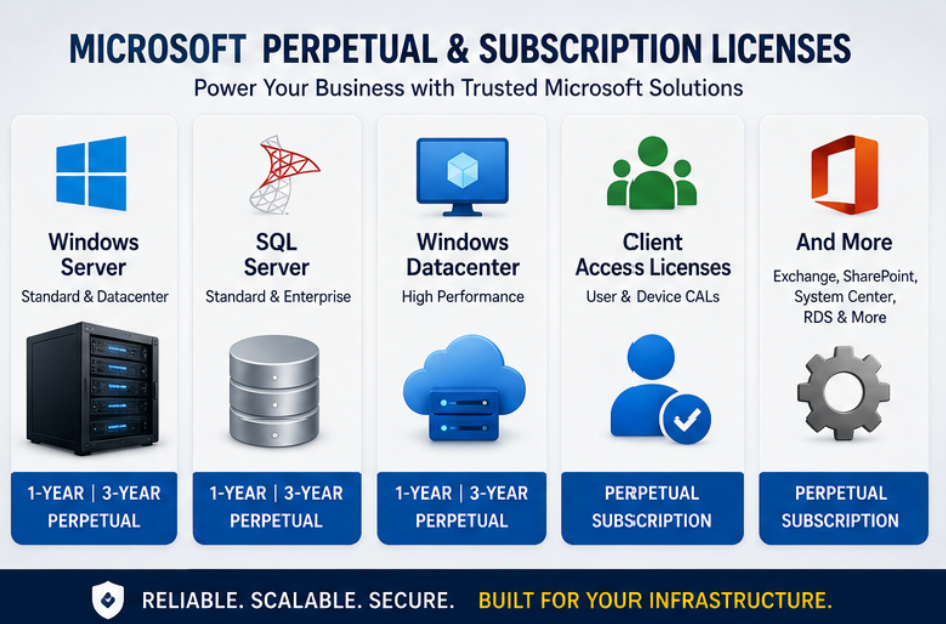
Therefore, as cloud computing continues to grow, many organizations still maintain on-premises environments that require reliable, secure, and cost-effective Microsoft server solutions. Microsoft continues to offer both perpetual licenses and subscription-based licensing options for core infrastructure products including Windows Server, SQL Server, Remote Desktop Services (RDS), System Center, Exchange Server, SharePoint Server, and more.
Hence, understanding the differences between perpetual licensing and subscription licensing can help organizations reduce costs, improve flexibility, and maximize return on investment.
Technology Solutions Worldwide helps organizations evaluate, purchase, deploy, and manage Microsoft licensing solutions. Most importantly, as a Microsoft CSP, Microsoft VAR, Microsoft MSP, Microsoft Solutions Partner, Microsoft Education Partner, Microsoft Government Partner, and Microsoft AOS-G Partner, we provide organizations with access to Microsoft perpetual licenses and subscription licenses at savings of 35–45% below Microsoft MSRP.
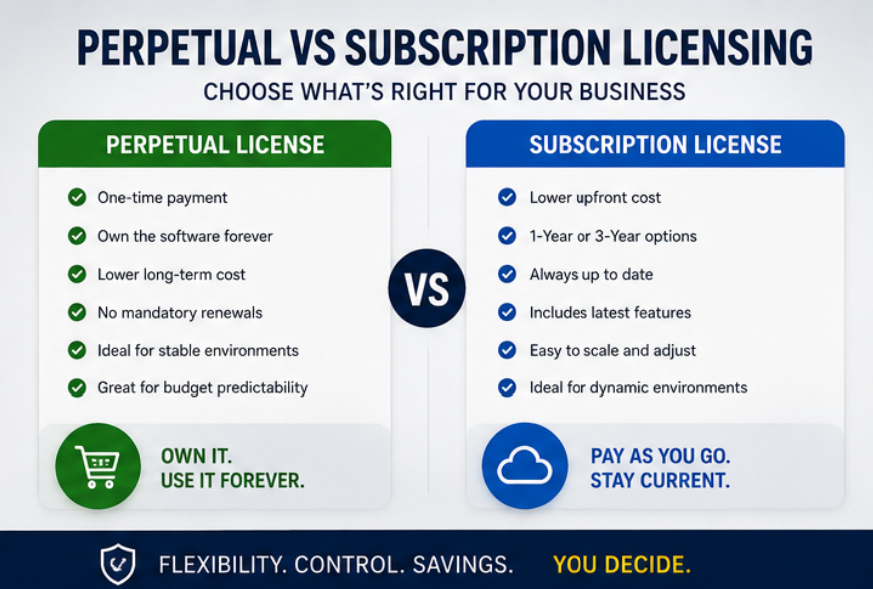
Microsoft Perpetual Licenses vs Microsoft Perpetual subscription
What Is a Microsoft Perpetual License?
A perpetual license is a one-time software purchase that grants the customer the right to use the software indefinitely.
Unlike subscription licensing, perpetual licenses do not require annual renewal to continue using the software.
Once purchased, the organization owns the software rights for that version permanently.
Examples include:
- Windows Server 2025 Standard
- Windows Server 2025 Datacenter
- SQL Server 2022 Standard
- SQL Server 2022 Enterprise
- Exchange Server Subscription Edition
- SharePoint Server Subscription Edition
- Remote Desktop Services (RDS) CALs
- Windows Server CALs
- SQL Server CALs
Organizations that prefer long-term stability and predictable ownership often choose perpetual licensing.
Benefits of Microsoft Perpetual Licensing
Long-Term Cost Savings
For organizations running workloads over multiple years, perpetual licensing often results in a lower total cost of ownership.
Rather than paying monthly or annual subscription fees forever, organizations make a single investment and continue using the software.
Example
A server that remains operational for 7–10 years may cost significantly less under a perpetual licensing model compared to recurring subscription costs.
Budget Predictability
Many organizations prefer capital expenditures (CapEx) rather than recurring operational expenses (OpEx).
Perpetual licensing provides:
- One-time procurement
- Predictable budgeting
- Reduced renewal management
- Lower recurring costs
This is particularly attractive to government agencies, educational institutions, and nonprofit organizations.
No Mandatory Subscription Renewals
Perpetual licenses continue functioning even if Software Assurance or support agreements expire.
Organizations maintain operational continuity without worrying about subscription expiration.
Greater Control
Perpetual licensing allows organizations to:
- Control upgrade schedules
- Maintain stable environments
- Reduce change management requirements
- Avoid forced migrations
Many industries require predictable software environments for regulatory or operational reasons.
Understanding Microsoft Subscription-Based Server Licensing
Microsoft has introduced subscription licensing options for many server products.
These solutions provide flexibility while lowering initial acquisition costs.
Organizations can choose:
- 1-Year Subscription Licenses
- 3-Year Subscription Licenses
Subscription licensing has become increasingly popular among organizations seeking lower upfront investments.
Benefits of Subscription Licensing
Lower Initial Costs
Rather than purchasing perpetual licenses upfront, organizations spread costs over time.
Benefits include:
- Reduced capital expenditures
- Easier budgeting
- Lower initial deployment costs
Access to New Versions
Subscription licensing often includes:
- Version upgrades
- Security updates
- Feature enhancements
Organizations remain current without requiring new perpetual purchases.
Scalability
Subscription licensing allows organizations to adjust licensing requirements as business needs evolve.
This flexibility is particularly useful for:
- Growing businesses
- Seasonal operations
- Project-based deployments
Microsoft Perpetual Licenses vs Microsoft Perpetual subscription
Microsoft Windows Server Licensing
Windows Server remains the foundation of many enterprise infrastructures.
Available editions include:
Windows Server Standard
Designed for:
- Small businesses
- Medium-sized organizations
- Basic virtualization environments
Features include:
- Active Directory
- File services
- DNS
- DHCP
- Hyper-V virtualization
- Storage services
Typical Microsoft MSRP
- Approximately $1,200–$1,500 per 16-core license
Pricing varies based on core count and purchasing channel.
Windows Server Datacenter
Designed for:
- Highly virtualized environments
- Large enterprises
- Private cloud deployments
Additional features include:
- Unlimited virtualization rights
- Software-defined networking
- Software-defined storage
- Advanced security
Typical Microsoft MSRP
- Approximately $6,000–$8,000+ per 16-core license
Pricing varies by server configuration.
Windows Server Subscription Licensing
Microsoft now offers subscription licensing options for Windows Server.
Available terms include:
Windows Server 1-Year Subscription
Benefits:
- Lower upfront investment
- Current version access
- Flexible budgeting
Windows Server 3-Year Subscription
Benefits:
- Better long-term value
- Predictable pricing
- Easier procurement planning
Many organizations select three-year terms because they align with technology refresh cycles.
Microsoft SQL Server Licensing
SQL Server remains one of the world’s most powerful database platforms.
Available editions include:
SQL Server Standard
Ideal for:
- Departmental databases
- Small to medium organizations
- Business applications
Features include:
- Database management
- Reporting Services
- Integration Services
- Business Intelligence
Typical Microsoft MSRP
- Approximately $4,000–$5,000 per 2-core license
SQL Server Enterprise
Designed for:
- Mission-critical workloads
- Large enterprises
- High-performance databases
Additional features include:
- Advanced analytics
- High availability
- Large-scale performance
- Enterprise security
Typical Microsoft MSRP
- Often exceeds $15,000–$18,000 per 2-core license
SQL Server Subscription Licensing
Organizations can also purchase SQL Server through subscription agreements.
Options typically include:
SQL Server 1-Year Subscription
Advantages:
- Lower upfront costs
- Easier budget approvals
- Current software versions
SQL Server 3-Year Subscription
Advantages:
- Better pricing efficiency
- Long-term planning
- Predictable budgeting
Microsoft Perpetual Licenses vs Microsoft Perpetual subscription
Microsoft Client Access Licenses (CALs)
Many Microsoft server products require CALs.
Examples include:
Windows Server CALs
Allow users or devices to access Windows Server services.
Typical MSRP:
- Approximately $40–$60 per CAL
Remote Desktop Services (RDS) CALs
Required for remote desktop access.
Typical MSRP:
- Approximately $120–$200 per user CAL
SQL Server CALs
Required for SQL Server Server + CAL deployments.
Pricing varies by licensing model and volume.
Other Microsoft Perpetual Solutions
Organizations may also purchase:
Exchange Server
- Subscription Edition
- Email infrastructure
- Hybrid deployment support
SharePoint Server
- Collaboration platform
- Document management
- Workflow automation
System Center
- Infrastructure management
- Monitoring
- Automation
Visual Studio
- Developer licensing
- Software development tools
Project Server
- Project portfolio management
Visio
- Diagramming and workflow design
Perpetual Licensing vs Subscription Licensing
| Feature | Perpetual License | Subscription License |
|---|---|---|
| Upfront Cost | Higher | Lower |
| Long-Term Cost | Lower | Higher |
| Ownership | Permanent | Subscription-Based |
| Version Upgrades | Additional Purchase | Included |
| Budget Flexibility | Moderate | High |
| Capital Expense | Yes | No |
| Operating Expense | Minimal | Ongoing |
| Scalability | Lower | Higher |
Which Licensing Model Is Right for You?
Choose Perpetual Licensing If:
- You prefer long-term ownership
- You have stable infrastructure
- You want lower long-term costs
- You operate highly controlled environments
- You maintain systems for many years
Choose Subscription Licensing If:
- You want lower upfront costs
- You require flexibility
- You frequently upgrade software
- You prefer operational expense budgeting
- You expect rapid organizational growth
Why Purchase Through Technology Solutions Worldwide?
Technology Solutions Worldwide helps organizations identify the most cost-effective Microsoft licensing strategy.
Our expertise includes:
- Microsoft CSP Licensing
- Microsoft Perpetual Licensing
- Microsoft Subscription Licensing
- Microsoft Government Licensing
- Microsoft Education Licensing
- Licensing Optimization
- Deployment Services
- Managed Services
- Security Consulting
Save 35–45% on Microsoft Licensing
Technology Solutions Worldwide provides substantial savings compared to Microsoft MSRP.
Benefits include:
✔ 35–45% Off Microsoft MSRP
✔ Microsoft Licensing Experts
✔ Flexible Purchasing Options
✔ Government & Education Expertise
✔ CSP and Perpetual Licensing Support
✔ Migration & Deployment Services
✔ Ongoing Technical Support
Contact Technology Solutions Worldwide
In conclusion, whether you need Windows Server, SQL Server, Datacenter Licensing, CALs, Exchange Server, SharePoint Server, Visual Studio, or subscription-based server licensing, Technology Solutions Worldwide can help you select the right solution at the best possible price.
Technology Solutions Worldwide
📞 (800) 998-2792
Our Microsoft licensing specialists can help your organization evaluate perpetual licensing, subscription licensing, hybrid cloud strategies, and long-term cost optimization opportunities while maximizing your return on investment.
Purchase Microsoft Volume Licenses here: https://techsolworld.com/product-category/microsoft-volume-licensing/
#MicrosoftVolumeLicensing #MicrosoftServerLicenses #MicrosoftOffice #MicrosoftWindows #MicrosoftSQL