
Microsoft Government Cloud is defined as a sovereign suite of cloud services built exclusively for U.S. government agencies and their authorized partners, operating from physically isolated datacenters with access restricted to screened U.S. persons. Hence, he suite includes Azure Government, Microsoft 365 Government Community Cloud (GCC), and Dynamics 365 for government. Moreover, each service carries FedRAMP High authorization and meets Department of Defense (DoD) Impact Level standards. To clarify, for IT professionals and government officials managing sensitive workloads, this is the cloud environment built to meet those requirements without requiring agencies to build compliance controls from scratch.
What is Microsoft Government Cloud and what does it include?
Microsoft Government Cloud is not a single product. In other words, it is an ecosystem of cloud platforms, each adapted from Microsoft’s commercial offerings and hardened for government use. Further, the three core components are Azure Government, Microsoft 365 GCC, and Dynamics 365 for government.
Azure Government is a dedicated cloud platform physically separated from commercial Azure. It runs on the same underlying technology as commercial Azure but adds contractual commitments for data residency and access controls limited to screened U.S. persons. For instance, azure Government holds FedRAMP High authorization and supports 68+ authorized services. Moreover, that breadth covers compute, networking, storage, databases, and advanced AI workloads.

Microsoft 365 GCC is a Platform as a Service built on Azure infrastructure with FedRAMP High certification tailored for government use. It delivers the full Microsoft 365 productivity suite, including Teams, Exchange Online, SharePoint, and OneDrive, with U.S. data residency and enhanced access controls. Above all, GCC High is a stricter tier for agencies handling Controlled Unclassified Information (CUI) under ITAR and EAR export control regulations.
Dynamics 365 for government extends Microsoft’s business applications to government operations. Agencies use it for case management, field service, and financial operations within a compliant environment.
| Service category | Government cloud availability | Commercial cloud availability |
|---|---|---|
| Core compute and storage | Full availability | Full availability |
| Microsoft 365 productivity | GCC and GCC High tiers | Standard commercial plans |
| Advanced AI (Azure OpenAI) | Authorized for all classification levels | Generally available |
| Confidential Computing VMs | Available across all government levels | Available |
| Dynamics 365 applications | Government-adapted versions | Full commercial versions |
Pro Tip: GCC and GCC High are not interchangeable. GCC suits most federal, state, and local agencies. GCC High is required when your data falls under ITAR, EAR, or DoD IL4 and IL5 mandates. Confirm your data classification before purchasing.
How does Microsoft Government Cloud handle security and compliance?
The security architecture of Microsoft cloud for government rests on three pillars: physical isolation, access restriction, and pre-configured compliance controls. Each pillar directly reduces the operational burden on agency IT teams.
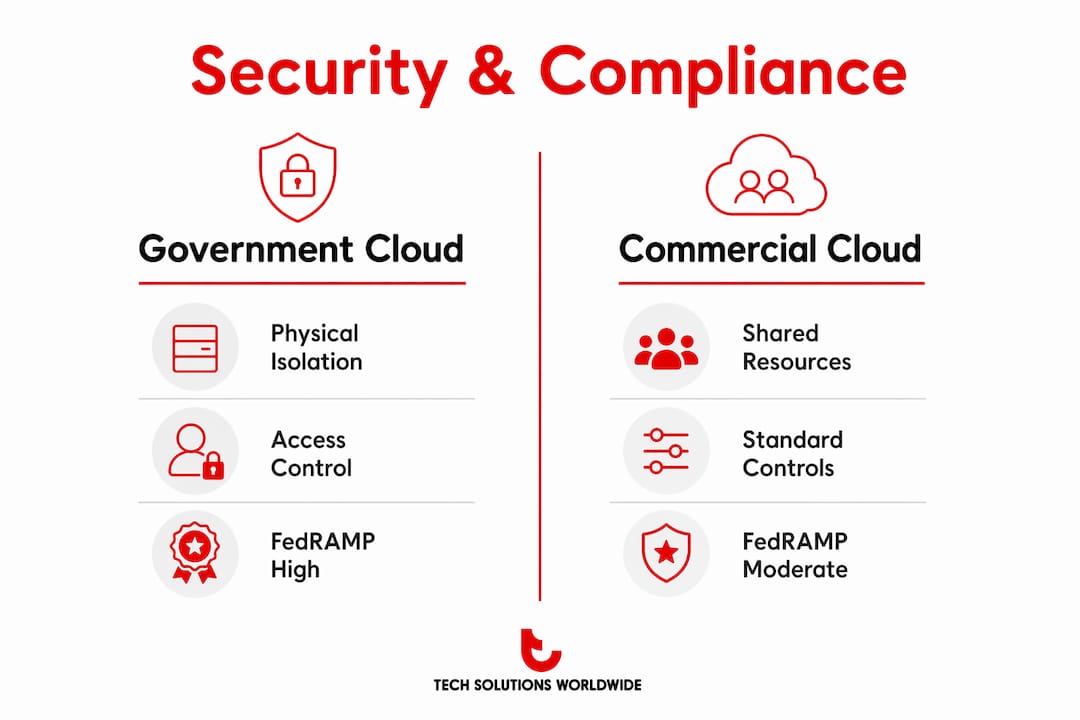
Physical isolation means Azure Government datacenters are located entirely within the United States and are not shared with commercial cloud customers. Access is limited to screened U.S. persons, satisfying U.S. export control regulations under ITAR and EAR. Consequently, this is a contractual commitment, not just a configuration setting.
The compliance certifications built into the platform include:
- FedRAMP High authorization across Azure Government and Microsoft 365 GCC
- DoD Impact Levels IL2, IL4, IL5, and IL6 for classified and sensitive defense workloads
- CJIS (Criminal Justice Information Services) compliance for law enforcement agencies
- IRS 1075 for agencies handling federal tax information
- HIPAA and HITECH for health data managed by government health agencies
Azure Confidential Computing adds a hardware layer to this framework. It uses Trusted Execution Environments (TEE) to protect data while it is actively being processed, not just at rest or in transit. Confidential VMs are generally available across all U.S. government data classification levels. That capability makes it practical to migrate sensitive workloads that previously could not run on any shared cloud infrastructure.
Azure OpenAI Service has been authorized for all U.S. government data classification levels, including top-secret IL6 environments. Agencies can deploy generative AI models within secure, air-gapped cloud environments. On the other hand, that authorization removes a major barrier for agencies seeking to apply AI to sensitive data.
Pro Tip: Request your agency’s Authority to Operate (ATO) documentation early. Azure Government’s pre-configured controls reduce the ATO timeline significantly, but the documentation process still requires internal coordination with your security officer.
How does Microsoft Government Cloud differ from commercial Azure and Microsoft 365?
The core difference is not technology. Similarly, it is eligibility, default controls, and feature parity. Azure Government uses the same core technologies as commercial Azure but applies stricter default configurations and contractual data protections that commercial plans do not offer.
Eligibility is the first gate. Access to Microsoft cloud for government requires being a U.S. government entity or a partner operating in a governmental capacity. This includes federal, state, local, tribal, and regional government entities. Commercial organizations without a qualifying government contract cannot access these environments.
Feature release timing is the most operationally significant difference. Advanced features appear first in commercial cloud before reaching government cloud. The delay varies by feature and can range from weeks to several months. Project managers must account for this when planning deployments that depend on specific platform capabilities.
| Dimension | Government cloud | Commercial cloud |
|---|---|---|
| Eligibility | U.S. government entities and qualifying partners | Any organization |
| Data residency | U.S. only, contractually guaranteed | Configurable, not always contractual |
| Default security controls | Pre-configured for FedRAMP High | Configurable by customer |
| Feature release timing | Delayed relative to commercial | First to receive new features |
| Compliance certifications | FedRAMP High, DoD IL2–IL6, CJIS, IRS 1075 | FedRAMP Moderate, standard certifications |
| Cost | Higher than commercial equivalents | Lower baseline cost |
The pre-configured secure foundation reduces the operational compliance burden on agencies. To clarify, that reduction is the primary financial justification for the higher cost. Agencies that would otherwise spend significant resources building and maintaining compliance controls get those controls included in the platform.
What are the key steps for adopting Microsoft Government Cloud?
Adoption requires more planning than a standard commercial cloud migration. Hence, with eligibility validation, procurement, and integration each carry specific requirements that differ from commercial deployments.
- Validate eligibility. Confirm your organization qualifies as a U.S. government entity or authorized partner. Most importantly, Microsoft requires documentation before granting access to government cloud environments.
- Select the correct tier. Choose between GCC, GCC High, or Azure Government based on your data classification requirements. Review your agency’s data types against DoD Impact Level definitions and ITAR/EAR applicability.
- Assess existing infrastructure. Map your current on-premises or commercial cloud workloads against service availability in Azure Government. Not every commercial Azure service has a government equivalent. Identify gaps before migration begins.
- Plan for feature lag. Build a feature parity review into your project timeline. Applications developed for Azure Government often require configuration adjustments because some commercial features are not yet available in the government environment.
- Configure security policies within Microsoft 365 GCC. Default controls are strong, but agencies must still configure Conditional Access, Data Loss Prevention (DLP), and Microsoft Purview compliance policies to match their specific security requirements.
- Establish ongoing compliance monitoring. Assign ownership for continuous compliance monitoring. FedRAMP High authorization requires agencies to maintain documentation and respond to audit requests. Azure Policy and Microsoft Defender for Cloud provide automated monitoring tools within the government environment.
Procurement typically runs through government contracting vehicles such as GSA Schedule, SEWP, or direct Microsoft Enterprise Agreements adapted for government. Technology Solutions Worldwide has over 20 years of experience supporting Microsoft Azure services procurement and deployment for government and enterprise clients.
Key Takeaways
Microsoft Government Cloud delivers pre-configured FedRAMP High compliance, physical data isolation, and DoD Impact Level certifications that commercial cloud plans do not provide by default.
| Point | Details |
|---|---|
| Sovereign infrastructure | Azure Government runs in U.S.-only datacenters with access limited to screened U.S. persons. |
| Pre-built compliance | FedRAMP High, DoD IL2–IL6, CJIS, and IRS 1075 certifications are included in the platform. |
| Tiered service options | GCC, GCC High, and Azure Government serve different classification and regulatory requirements. |
| Feature release lag | New capabilities reach government cloud after commercial cloud, requiring adjusted project timelines. |
| Eligibility gate | Only U.S. government entities and qualifying partners can access government cloud environments. |
Technology Solutions Worldwide’s perspective on government cloud adoption
After working with government agencies and enterprise clients on Microsoft cloud migrations for over two decades, the pattern is consistent. Consequently, agencies underestimate the planning phase and overestimate the complexity of the migration itself.
The compliance framework in Azure Government and Microsoft 365 GCC is genuinely well-built. Moreover, the pre-configured controls remove months of custom security work. As a result, the real friction comes from two places: eligibility documentation and feature parity gaps. Hence, agencies that start the eligibility validation process late lose weeks they cannot recover. For instance, teams that build deployment timelines without checking the GCC vs. GCC High differences often discover mid-project that they selected the wrong tier.
The Confidential Computing capability is underused. Additionally, most agencies focus on data at rest and in transit but overlook data in use. In other words, trusted Execution Environments protect workloads during active processing. Hence, that matters for AI inference on classified data and for any workload where the compute layer itself is a threat surface.
The feature lag is real but manageable. Hence, the practice of reviewing the Azure Government feature roadmap quarterly and building a 90-day buffer into deployment schedules for any feature that is not yet generally available in the government environment works well. Above all, that buffer prevents last-minute scope changes.
The agencies that succeed with government cloud adoption treat it as a compliance program first and a technology project second. Therefore, the technology is mature. The compliance documentation, the access reviews, and the ongoing monitoring are where the work actually lives.
— Technology Solutions Worldwide
Microsoft Government Cloud licensing support from Technology Solutions Worldwide
Government cloud licensing is more complex than standard commercial Microsoft subscriptions. Tier selection, eligibility validation, and volume agreement structuring each affect total cost and compliance posture.
Technology Solutions Worldwide is a certified Microsoft Solutions Partner with over 20 years of experience in Microsoft licensing support for government and enterprise clients. Most importantly, the firm provides 20–30% discounts off standard Microsoft subscription pricing and manages the full procurement process, from eligibility documentation through contract execution. Certainly, government agencies and IT teams can review Office 365 Government subscription options directly on the Technology Solutions Worldwide platform to compare GCC and GCC High tiers by feature set and price.
FAQ
What is Microsoft Government Cloud used for?
Microsoft Government Cloud provides U.S. government agencies with secure cloud infrastructure, productivity tools, and compliance-ready platforms for sensitive and mission-critical workloads. It covers use cases from email and collaboration to AI inference on classified data.
Who qualifies for Microsoft Government Cloud access?
Eligibility requires being a U.S. government entity or an authorized partner operating in a governmental capacity, including federal, state, local, tribal, and regional government organizations. Microsoft validates eligibility before granting access.
What is the difference between GCC and GCC High?
GCC suits most federal, state, and local agencies handling standard government data. GCC High is required for agencies managing data subject to ITAR, EAR, or DoD Impact Level IL4 and IL5 requirements.
Does Microsoft Government Cloud support AI services?
Azure OpenAI Service is authorized for all U.S. government data classification levels, including top-secret IL6 environments. Agencies can run generative AI models within secure, air-gapped government cloud infrastructure.
How long does it take to migrate to Microsoft Government Cloud?
Migration timelines vary by workload complexity, but eligibility validation and compliance documentation typically add several weeks to the process compared to a commercial cloud migration. Hence, planning for feature parity gaps and ATO documentation is the most time-intensive part.
Recommended
- Microsoft GCC – Government Subscriptions – Technology Solutions
- Microsoft Office 365 Government Subscriptions – Technology Solutions
- Microsoft Government – MICROSOFT GCC vs MICROSOFT GCC High – Technology Solutions
- Understanding Office 365 Government GCC Subscriptions: G1, G3, and G5 – Technology Solutions
PURCHASE MICROSOFT GOVERNMENT LICENSES FOR 30-40% OFF DIRECTLY HERE.