
A Microsoft Gold Partner is a company vetted by Microsoft to demonstrate high technical expertise, verified customer success, and continuous staff certification. The designation signals that a partner meets strict performance standards, not just a one-time test. For IT managers and business decision-makers, understanding why Microsoft Gold partner matters is the difference between choosing a qualified technology provider and one that simply claims expertise. The program has evolved significantly since 2022, and knowing the current framework helps you make a better-informed decision.
Why Microsoft Gold partner status has changed
The term “Microsoft Gold Partner” is now a legacy label. Microsoft retired the Gold and Silver partner tiers and replaced them with the Microsoft AI Cloud Partner Program as of 2026. The new framework centers on the Microsoft Solutions Partner designation, which covers six defined solution areas: Business Applications, Data and AI, Digital and App Innovation, Infrastructure, Modern Work, and Security.
The core evaluation tool is the Partner Capability Score (PCS). Partners must maintain a minimum PCS of 70 out of 100, evaluated monthly. The score reflects three dimensions: performance (net new customer growth), skilling (certified staff), and customer success (deployment and usage outcomes). Only 23% of partners reach the elite threshold of 85 or above. That gap matters when you are comparing providers.
Key facts about the current designation framework:
- Six solution areas: Each carries its own PCS, so a partner may hold the designation in Modern Work but not in Security.
- Monthly scoring: PCS updates every month, meaning a partner’s status reflects current performance, not a credential earned years ago.
- Annual renewal: Partners must renew their designation annually by maintaining performance metrics across all active solution areas.
- Legacy badge retirement: The old Gold and Silver badges were retired in 2022 and fully phased out by january 2025.
The shift from static badges to dynamic performance scoring represents a fundamental change in how Microsoft measures partner quality. A partner who earned Gold status in 2019 and has not updated their credentials is not equivalent to one holding a current Solutions Partner designation.
What benefits does working with a certified partner deliver?
Certified Microsoft Solutions Partners provide advantages that go beyond general IT consulting. These benefits are tied directly to the partner’s verified status within the Microsoft ecosystem.
- Priority technical support. Certified partners receive priority access to Microsoft’s technical support channels and escalation routes. This means faster issue resolution and less downtime for your organization.
- Advance product notice. Partners get early notification of product changes, updates, and new feature releases. Your team can plan migrations and upgrades before changes affect operations.
- License cost optimization. Licensing guidance from certified partners helps businesses avoid over-licensing and under-licensing. Both errors carry real financial costs, and a qualified partner aligns your license portfolio to actual usage.
- Verified staff certifications. The PCS skilling metric requires that partner staff hold current Microsoft certifications. You are not relying on one certified employee. The entire team must meet the standard.
- Co-sell and referral access. Solutions Partners participate in Microsoft’s co-sell program, which connects them with Microsoft sales teams on joint opportunities. This gives clients access to Microsoft resources that are not available through uncertified providers.
Pro Tip: Ask any prospective partner to show you their current PCS breakdown by solution area before signing a contract. A partner confident in their credentials will share this data without hesitation.
The Solutions Partner designation also acts as a trust signal that simplifies your technical vetting process. Rather than auditing a partner’s internal training records, you can rely on Microsoft’s verified proof of expertise and ongoing certification as a baseline.

Why the old Gold badge is no longer a reliable signal
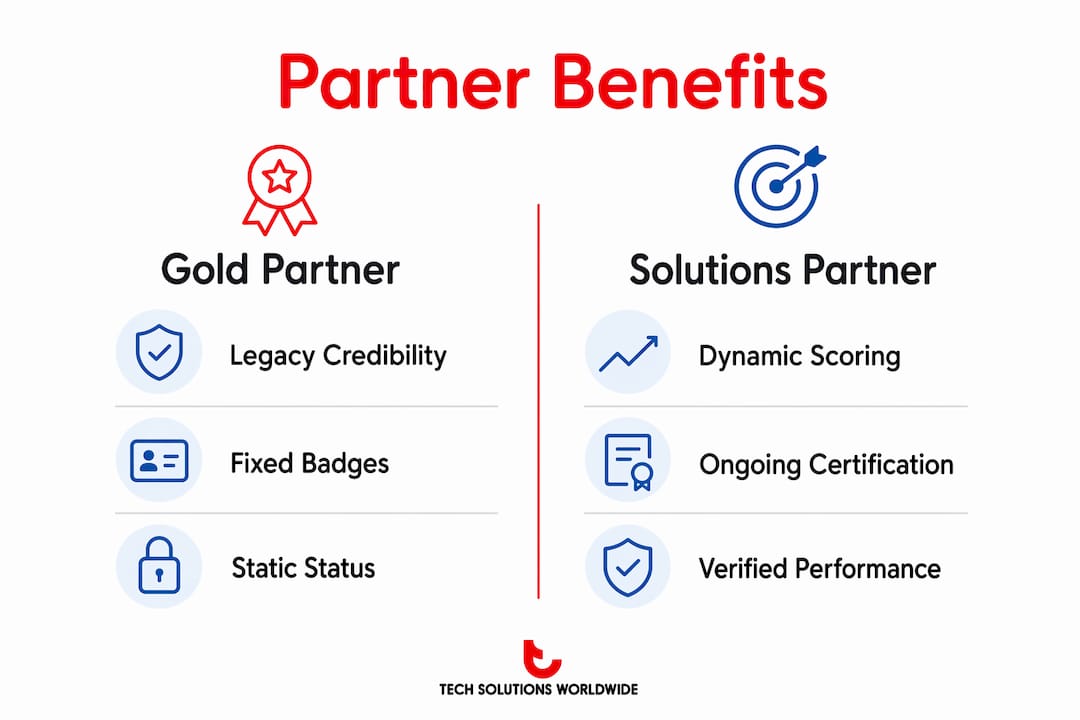
The legacy Gold badge carried real weight when it was active. Partners had to demonstrate competency in specific Microsoft technology areas and meet customer reference requirements. The problem is that the badge became static. A partner could earn Gold status and coast on it for years without updating skills or improving customer outcomes.
Partners advertising the old Gold Partner badge after 2022 may be misrepresenting their current status. The designation was retired and fully phased out by january 2025. Seeing that badge on a partner’s website today is a red flag, not a credential.
The PCS replaced the badge precisely because it measures what actually matters: ongoing technical investment and real customer results. A partner with a PCS of 85 or above has demonstrated consistent performance across multiple months. A partner showing a retired Gold badge has demonstrated nothing about their current capabilities.
Pro Tip: Search for any partner’s current designation directly on the Microsoft Partner Finder tool. If their profile does not show an active Solutions Partner badge in the relevant solution area, their credentials are not current.
Advanced Specializations add another layer above the base Solutions Partner designation. These require third-party audits or customer reference verification to prove capability in specific technology areas such as Azure Virtual Desktop, Threat Protection, or Identity and Access Management. Holding an Advanced Specialization signals a deeper level of verified expertise than the base designation alone.
How to choose the right Microsoft partner in 2026
Selecting a Microsoft Solutions Partner requires more than checking a badge. Use these criteria to evaluate any provider before committing:
- Request the PCS breakdown. Ask for the partner’s current score in each solution area relevant to your project. A score below 70 in your target area disqualifies the partner for that work.
- Verify Advanced Specializations. If your project involves Azure migration, security, or Modern Work deployment, ask whether the partner holds the relevant Advanced Specialization. These require verified audits and carry more weight than the base designation.
- Review the support model. Understand how the partner handles escalations. Certified partners have direct Microsoft support channels. Confirm that your contract includes access to those channels, not just the partner’s internal help desk.
- Assess sector experience. Certification status and sector knowledge are separate. A partner certified in Modern Work may have limited experience in regulated industries like healthcare or government. Ask for customer references in your sector.
- Check credentials publicly. Use the Microsoft Partner Finder to verify any partner’s active designations and solution areas before your first meeting.
- Evaluate licensing expertise. Ask how the partner approaches license audits and optimization. A qualified partner will have a defined process for aligning your Microsoft 365, Azure, or Dynamics 365 licenses to actual usage.
The partner evaluation process should be treated the same way you would evaluate any critical vendor. Credentials are the starting point, not the finish line.
What financial incentives do Advanced Specializations unlock?
Advanced Specializations deliver financial benefits that directly affect the cost of your Microsoft projects. Partners holding these designations gain access to End Customer Investment Funds (ECIF), which range from $10,000 to over $100,000 per deal. These funds subsidize project costs for qualifying engagements.
ECIF eligibility requires the partner to meet specific audit or customer reference thresholds. The funds are not automatic. They are tied to verified performance and the scope of the engagement. For large Azure migrations or enterprise Microsoft 365 deployments, ECIF can represent a significant reduction in your total project cost.
Additional financial and strategic benefits from Advanced Specializations include:
- Co-sell referral priority. Microsoft’s sales teams actively refer clients to partners with Advanced Specializations, increasing the partner’s pipeline and their motivation to maintain high standards.
- Incentive funding for training. Partners receive funding to upskill their teams, which directly benefits clients through more current technical knowledge.
- Stronger project support. Partners with specializations have direct access to Microsoft engineering resources during complex deployments. That access translates into faster problem resolution on your projects.
These incentives motivate partners to continuously improve their capabilities rather than rely on a credential earned years ago. For clients, this means the partner you engage today has a financial reason to stay current.
Key Takeaways
The Microsoft Solutions Partner designation is the current standard for evaluating partner quality, replacing the retired Gold badge with a monthly performance-based scoring system.
| Point | Details |
|---|---|
| Gold badge is retired | Partners still showing the old Gold badge after 2025 are displaying an obsolete credential. |
| PCS is the real metric | Request a partner’s Partner Capability Score breakdown by solution area before signing any contract. |
| Advanced Specializations add value | These require third-party audits and unlock ECIF funds ranging from $10,000 to over $100,000 per deal. |
| Annual renewal is required | Solutions Partners must maintain performance metrics every year to keep their designation active. |
| Sector experience matters | Certification status and industry knowledge are separate. Verify both before committing to a partner. |
The credential gap most decision-makers miss
After working in the Microsoft partner ecosystem for over 20 years, Technology Solutions Worldwide has seen a consistent pattern: decision-makers focus on whether a partner has a badge and skip the question of what that badge actually measures today.
The retirement of the Gold badge created a gap that many partners have exploited. A company that earned Gold status in 2020 and has not pursued the Solutions Partner designation is operating without current verified credentials. Yet that same company may still display Gold Partner branding on its website, in proposals, and in sales conversations. The burden falls on the buyer to ask the right questions.
The PCS system is a genuine improvement because it forces partners to earn their status every month. A score of 85 or above in a given solution area is not a marketing claim. It is a number tied to real customer deployments, certified staff, and net new growth. Demanding that number from any prospective partner is the single most effective filter available to IT managers today.
The ecosystem shift also benefits clients in a less obvious way. Because partners are scored on customer success outcomes, not just certifications, their financial incentive now aligns with your project results. A partner who helps you deploy Microsoft 365 successfully improves their own PCS. That alignment did not exist under the old Gold badge system.
— Technology Solutions Worldwide
Microsoft licensing support from Technology Solutions Worldwide
Technology Solutions Worldwide is a certified Microsoft Solutions Partner with over 20 years of experience in Microsoft licensing support and migration services. The firm serves organizations ranging from government agencies to enterprise clients including Coca-Cola and T-Mobile, delivering 20–30% discounts off standard Microsoft subscription pricing.
Technology Solutions Worldwide’s licensing specialists help clients align Microsoft 365, Azure, and Dynamics 365 licenses to actual usage, eliminating waste and reducing IT budget exposure. The team holds current Solutions Partner credentials and provides direct access to Microsoft’s priority support channels. For organizations planning a migration or facing a licensing audit, Technology Solutions Worldwide offers a clear, structured process with verified credentials backing every recommendation. Learn more about Microsoft licenses and migration services available for your organization.
FAQ
What is a Microsoft Solutions Partner?
A Microsoft Solutions Partner is a company that holds a current designation under the Microsoft AI Cloud Partner Program, verified through a monthly Partner Capability Score of at least 70 out of 100 across defined solution areas.
Is the Microsoft Gold Partner badge still valid?
The Gold Partner badge was retired in 2022 and fully phased out by january 2025. Partners displaying it today are showing an obsolete credential that no longer reflects current Microsoft verification standards.
What is the Partner Capability Score?
The Partner Capability Score (PCS) is a monthly metric scored out of 100 that measures a partner’s technical certifications, net new customer growth, and customer success outcomes across each Microsoft solution area.
How do Advanced Specializations differ from the base designation?
Advanced Specializations require third-party audits or verified customer references beyond the base Solutions Partner criteria, and they unlock access to End Customer Investment Funds ranging from $10,000 to over $100,000 per qualifying deal.
How can I verify a partner’s current Microsoft credentials?
Use the Microsoft Partner Finder tool to check any partner’s active Solutions Partner designations and solution areas. A partner with current credentials will appear with their active badge and relevant solution area listed publicly.
Recommended
- Trusted Microsoft Partners in Canada:
- How to Evaluate Microsoft Partners in Canada Effectively
- Microsoft licenses and migration services
- Key Factors for Choosing a Microsoft Dynamics 365 Partner in Canada – Technology Solutions
VIEW A FULL LINE UP OF DISCOUNTED MICROSOFT 365 BUSINESS, MICROSOFT 365 ENTERPRISE, MICROSOFT 365 GCC, AND MICROSOFT EDUCATION LICENSES HERE.