
Government compliance cloud deployment is the process of implementing cloud computing solutions that meet the regulatory, security, and data sovereignty requirements mandated for government use. That is to say, for federal agencies, this means aligning every deployment decision with frameworks like FedRAMP, ITAR, and DoD impact level standards. The stakes are high: a misconfigured cloud environment can expose Controlled Unclassified Information (CUI) and trigger legal liability. Certainly, the FedRAMP Consolidated Rules for 2026 (CR26) have reset the compliance baseline, and agencies that delay adaptation risk losing certification privileges entirely.
What are the key government cloud compliance requirements?
FedRAMP is the primary certification framework for cloud services used by federal agencies. Subsequently, the program currently lists 529 FedRAMP certified cloud services as of june 25, 2026, including 29 certified under the new FedRAMP 20x designation. On the other hand, that number reflects how broadly cloud adoption has spread across government, and how much choice compliance officers now have when selecting authorized platforms.
The most consequential change in 2026 is the launch of CR26. The FedRAMP Consolidated Rules for 2026 require all stakeholders to adopt the new rules by january 1, 2027, after which legacy Rev5 certification applications will not be accepted. Most importantly, the Rev5 phase-out follows on June 11, 2027. Consequently, agencies that do not begin transitioning now will lose the ability to use existing Rev5 packages.
Beyond FedRAMP, compliance officers must account for:
- FedRAMP Moderate: Required for non-sensitive federal workloads with limited CUI exposure.
- FedRAMP High: Required for systems where a breach would cause severe harm to agency operations or national security.
- DoD IL4: Covers CUI workloads for Department of Defense systems.
- DoD IL5/IL6: Reserved for mission-critical and classified DoD operations requiring maximum isolation.
- ITAR compliance: Mandates that export-controlled technical data stays within U.S. person access boundaries.
Pro Tip: Start your CR26 transition review now. Agencies that wait until late 2026 will face a compressed timeline for updating security packages, increasing the risk of authorization gaps.
How to select the best compliant cloud platform for government workloads
Platform selection starts with data classification. Cloud deployment must match data sensitivity: GCC or FedRAMP Moderate environments suit non-ITAR federal agencies, GCC High or IL4 covers CUI workloads, and DoD IL5 or IL6 handles mission-critical sensitive DoD operations. In other words, picking the wrong tier is not a minor error. It is a compliance failure that can void an agency’s authorization to operate.

One detail many compliance officers miss: not all services within a FedRAMP High authorized platform are automatically approved for every workload. Each Authorized Cloud Service Offering (CSO) has a defined boundary. A specific feature or add-on may fall outside that boundary, even if the platform itself carries a High authorization. Verifying the exact CSO scope before deployment is non-negotiable.
Commercial cloud regions do not meet the legal data sovereignty and U.S. person access requirements for ITAR and sensitive DoD data. Isolated government cloud environments, such as Azure Government or AWS GovCloud, exist specifically to satisfy these requirements. Using a standard commercial region for ITAR-controlled data is a legal violation, not just a configuration gap.
| Feature category | Public commercial cloud | Government-isolated cloud | Private/on-premises hybrid |
|---|---|---|---|
| FedRAMP authorization | Moderate only | Moderate, High, IL4–IL6 | Agency-managed |
| Data sovereignty | Not guaranteed | U.S. person access enforced | Full agency control |
| Security control automation | Limited | Assured workloads, policy guardrails | Manual or custom tooling |
| Deployment speed | Fastest | Moderate | Slowest |
| Cost model | Pay-as-you-go | Government pricing tiers | High upfront capital |
Pro Tip: Review the Office 365 Government GCC subscription tiers before selecting a Microsoft environment. GCC and GCC High serve different compliance levels and are not interchangeable.
What are the prerequisites for compliant cloud deployment in government?
Compliance work begins before any cloud resource is provisioned. Agencies must complete a formal risk assessment, establish baseline security controls aligned with NIST SP 800-53, and document data classification policies. Skipping these steps creates gaps that surface during FedRAMP authorization reviews and cause costly delays.
The shared responsibility model defines who controls what. Agencies must configure security, manage identity and access management (IAM), and enforce data boundaries even on fully authorized cloud platforms. The cloud provider secures the infrastructure. The agency secures everything it deploys on top of it. This distinction is where most compliance failures originate.
| Tool or framework | Purpose | Applies to |
|---|---|---|
| NIST SP 800-53 | Security control baseline | All federal cloud deployments |
| FedRAMP Marketplace | Verify authorized CSOs | Platform selection |
| Infrastructure as Code (IaC) | Automate configuration and policy enforcement | Deployment and drift detection |
| Assured Workloads | Enforce data residency and access controls | GCC High, DoD environments |
| OSCAL (machine-readable packages) | Automate compliance documentation under CR26 | FedRAMP authorization packages |
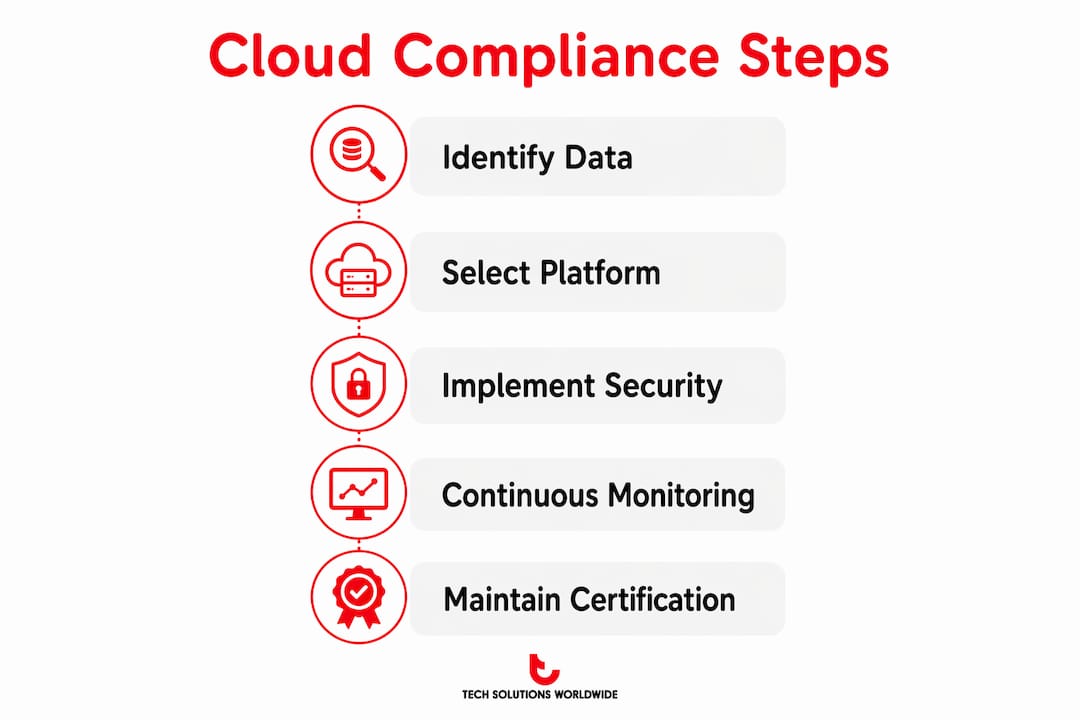
Key preparatory steps every agency must complete before deployment:
- Classify all data assets using the agency’s data governance policy.
- Map each data type to the appropriate FedRAMP or DoD impact level.
- Identify which CSOs on the FedRAMP Marketplace cover the planned workloads.
- Define IAM roles, access boundaries, and least-privilege policies in writing.
- Establish a continuous monitoring plan that meets FedRAMP requirements.
For agencies working within the Microsoft ecosystem, cloud security features like Microsoft Defender for Cloud and Microsoft Purview provide built-in controls that reduce manual compliance effort. Cyber defense resources from outlets like Cyber Defense Magazine also track emerging government cloud security threats that agencies should factor into their risk assessments.
Step-by-step process to execute a secure government cloud deployment
A structured deployment process prevents the configuration errors that cause authorization failures. Follow these steps in sequence:
- Define the authorization boundary. Document exactly which systems, data flows, and users fall within the cloud environment’s scope. For instance, ambiguous boundaries are the leading cause of FedRAMP review rejections.
- Select an authorized CSO. Verify the platform and specific services on the FedRAMP Marketplace. Therefore, confirm the authorization level matches your data classification requirements.
- Apply baseline security controls. Use Infrastructure as Code to deploy NIST SP 800-53 controls at provisioning time. Manual configuration introduces drift and inconsistency.
- Configure IAM and data boundaries. Enforce least-privilege access, multi-factor authentication, and data residency policies before any workload goes live.
- Conduct pre-deployment security testing. Run vulnerability scans and penetration tests against the configured environment. Address all high and critical findings before proceeding.
- Submit for authorization. For new deployments, work with a Third Party Assessment Organization (3PAO) to complete the security assessment. Under CR26, packages must use machine-readable OSCAL formats.
- Activate continuous monitoring. FedRAMP requires ongoing monitoring post-authorization. Set up automated alerting for configuration drift, access anomalies, and vulnerability disclosures.
Pro Tip: Integrate FedRAMP continuous monitoring into your DevSecOps pipeline from day one. Agencies that treat monitoring as a post-deployment task consistently miss the monthly reporting cadence required for authorization maintenance.
CR26 improves transparency and reusability of security packages, which speeds authorization and gives agencies more confidence when planning migrations through 2028. Agencies that adopt CR26 early gain access to reusable authorization components that reduce the cost of future deployments. Likewise, for agencies managing Microsoft 365 environments, understanding tenant migration processes is directly relevant to moving workloads between compliance tiers.
How to maintain ongoing compliance after cloud deployment
FedRAMP authorization is not a one-time event. Treating FedRAMP as an ongoing risk management program rather than a checklist prevents the expensive rework that follows a lapsed authorization. For instance, agencies must maintain a continuous monitoring posture that covers vulnerability scanning, incident response, and annual reauthorization reviews.
CR26 requires agencies to begin adopting the new rules immediately to avoid losing the ability to use existing Rev5 packages after January 1, 2027. That deadline applies to both new and existing authorizations. Therefore, agencies with active Rev5 packages must plan their transition now.
Best practices for ongoing compliance management:
- Run automated vulnerability scans on a weekly cadence and remediate critical findings within 30 days.
- Review IAM roles and access permissions quarterly to catch privilege creep.
- Automate compliance documentation using machine-readable OSCAL packages under CR26 to replace manual template updates.
- Conduct tabletop incident response exercises twice per year to test agency readiness.
- Monitor the FedRAMP Marketplace for changes to your CSO’s authorization status, as providers can update or restrict their authorization boundaries.
- Assign a dedicated compliance officer with authority to halt deployments that fail security reviews.
Microsoft Cloud App Security provides real-time visibility into cloud application activity, which supports the continuous monitoring requirements that FedRAMP mandates. Hence, agencies using Microsoft government environments can use this capability to automate a significant portion of their monthly reporting obligations.
Key Takeaways
Government compliance cloud deployment succeeds when agencies treat FedRAMP as a continuous risk management program, match data classification to the correct cloud environment, and adopt CR26 processes before the january 1, 2027 deadline.
| Point | Details |
|---|---|
| Match data to environment | Use GCC for non-ITAR workloads, GCC High or IL4 for CUI, and DoD IL5/IL6 for mission-critical operations. |
| Verify CSO boundaries | Confirm that specific services within an authorized platform cover your exact workload before deployment. |
| Adopt CR26 immediately | Legacy Rev5 packages become invalid after january 1, 2027; transition planning must start now. |
| Apply shared responsibility | Agencies configure IAM, data boundaries, and security controls even on fully authorized platforms. |
| Automate compliance documentation | Use OSCAL machine-readable packages under CR26 to replace manual templates and reduce reporting errors. |
What Technology Solutions Worldwide has learned about government cloud compliance
The agencies that struggle most with FedRAMP are the ones that treat it as a procurement step rather than an architecture requirement. Additionally, Technology Solutions Worldwide has worked with government clients long enough to see this pattern repeat: an agency selects an authorized platform, assumes compliance follows automatically, and then discovers during a 3PAO assessment that dozens of controls were never configured. Hence, the shared responsibility model is not theoretical. Consequently, it is the source of most authorization delays.
The 2026 CR26 update is genuinely useful for agencies willing to engage with it early. Therefore, the shift to machine-readable OSCAL packages eliminates the manual document maintenance that consumed compliance teams for years. As a result, agencies that adopt CR26 processes now will have reusable authorization components that cut the cost of every future deployment. Those that wait will face a compressed transition under deadline pressure.
The other lesson worth stating plainly: compliance and performance are not in conflict. In conclusion, agencies sometimes accept degraded application performance as the price of running in a government-isolated environment. For instance, that trade-off is rarely necessary. Proper architecture planning, combined with the right Microsoft licensing tier, delivers both security and the performance government workloads require.
— Technology Solutions Worldwide
Government cloud compliance support from Technology Solutions Worldwide
Technology Solutions Worldwide provides Microsoft licensing and migration services built for the compliance requirements government agencies face.
Technology Solutions Worldwide holds Microsoft Solutions Partner status and brings over 20 years of experience supporting government and enterprise clients. The team provides Microsoft licensing support for GCC, GCC High, and DoD environments, with discounts of 20–30% off standard Microsoft subscription pricing. For agencies managing a cloud migration or transitioning between compliance tiers, the migration and licensing services cover the full process from environment selection through authorization support.
FAQ
What is government compliance cloud deployment?
Government compliance cloud deployment is the process of deploying cloud services that meet federal regulatory requirements, including FedRAMP authorization, data sovereignty rules, and DoD impact level standards. Every configuration decision must align with the applicable security framework for the data being processed.
What is the CR26 deadline for FedRAMP compliance?
The FedRAMP Consolidated Rules for 2026 become mandatory by january 1, 2027, after which legacy Rev5 certification applications will not be accepted. The Rev5 phase-out completes on june 11, 2027.
How do I choose between GCC and GCC High for my agency?
GCC suits non-ITAR federal agencies handling standard federal data, while GCC High is required for CUI workloads and agencies subject to ITAR or DoD IL4 requirements. The classification of your data determines the correct environment, not the size of your agency.
Does a FedRAMP High authorization cover all services on a platform?
No. A FedRAMP High authorization applies to the specific Authorized Cloud Service Offering, not every feature or add-on the provider offers. Compliance officers must verify that each service used in a deployment falls within the authorized boundary.
What does the shared responsibility model mean for government agencies?
The cloud provider secures the underlying infrastructure. The agency is responsible for configuring security controls, managing IAM, and enforcing data boundaries within its cloud environment. Authorization of the platform does not transfer these responsibilities to the provider.
Recommended
- Understanding Office 365 Government GCC Subscriptions: G1, G3, and G5 – Technology Solutions
- Microsoft Office 365 Government Subscriptions – Technology Solutions
- Crafting the Perfect Office 365 Plan: A Comprehensive Guide – Technology Solutions
- Microsoft Cloud App Security for Enhanced Protection – Technology Solutions
PURCHASE GOVERNMENT LICENSES FOR GCC HIGH OR GCC LOW DIRECTLY HERE.