
An enterprise license agreement (ELA) is a legally binding, multi-year contract that grants an organization-wide software license at fixed, discounted rates. ELAs consolidate multiple individual licenses into a single agreement, replacing fragmented procurement with one contract covering all users, departments, and locations. ELAs typically run 3–5 years and deliver discounts of 22–40% compared to standard list prices for organizations with annual contract values above $1 million. Additionally, that discount range makes ELAs one of the most financially significant decisions in enterprise software procurement. Therefore, understanding the full structure of an enterprise license agreement explained correctly means going beyond the headline discount to examine cost structure, compliance obligations, and negotiation terms.
How does an enterprise license agreement work?
An ELA grants unlimited deployment rights across covered products for the full contract term. Hence, that means an organization can add users, expand to new business units, or deploy across additional locations without triggering a new purchase order. The practical effect is significant: IT and procurement teams stop managing per-seat renewals and focus instead on one annual review cycle.

The contract period is fixed, typically 3–5 years, with pricing locked at the agreed rate. Vendors build in a true-up provision, which requires an annual reconciliation of actual software usage against the licensed quantity. If actual usage exceeds the contracted baseline, the organization pays the difference at the agreed unit rate. If usage falls short, the organization generally receives no credit.
Common ELA terms include:
- Ramp clauses: Graduated payment schedules that increase annual fees over the contract term, often tied to projected user growth.
- Renewal caps: Limits on how much a vendor can raise prices at renewal, typically expressed as a percentage of the prior year’s fee.
- Support and maintenance fees: Annual charges, usually calculated as a percentage of the base license cost, covering updates, patches, and technical support.
- Usage bands: Predefined tiers of consumption that determine per-unit pricing at true-up.
Pro Tip: Request a contract glossary from the vendor before negotiations begin. Vendors use precise legal definitions for terms like “authorized user” and “deployment.” Misreading one definition can change your true-up liability by hundreds of thousands of dollars.
ELAs also restrict mid-term adjustments. Careful upfront planning is required to align the contract scope with forecasted organizational growth. Signing a contract sized for 500 users when the organization expects to reach 800 within two years creates a predictable and avoidable true-up problem.
What does an enterprise license cost structure look like?
The headline discount is rarely the full financial picture. ELA pricing has four distinct cost layers, and decision-makers who focus only on the license discount often face budget overruns in years two and three of the contract.
| Cost Component | Typical Range | Notes |
|---|---|---|
| Base license discount | 22–40% off list price | Applies to organizations with ACV above $1 million |
| Annual support and maintenance | 18–22% of license cost | Perpetual license models; SAP commonly exceeds 20% |
| Implementation and integration | Varies; often exceeds license savings | Post-license costs frequently drive long-term budgets |
| True-up liability | Unpredictable without tracking | 32% of organizations face over $1 million in audit exposure |
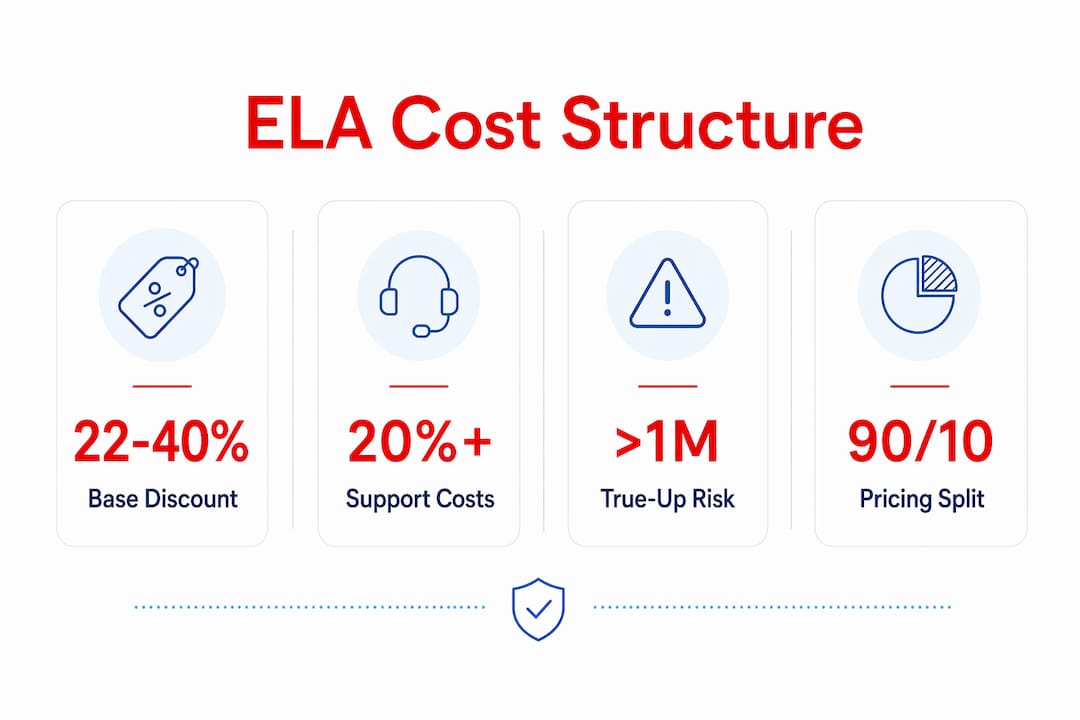
Support costs commonly exceed 20% of annual license fees in perpetual license models. That figure means a $2 million license agreement carries $400,000 or more in annual support costs alone, before any implementation or integration work begins.
Implementation and integration costs can exceed the value of the initial licensing discount over the full contract term. Vendors present the discount prominently during sales cycles. Post-license support costs receive far less attention but drive the actual total cost of ownership.
The true-up provision creates the most unpredictable cost exposure. Approximately 32% of organizations face over $1 million in audit liabilities due to poor license data management and true-up compliance failures. That statistic reflects a systemic problem: most organizations sign ELAs without a reliable system for tracking actual software usage in real time.
A best practice pricing structure uses a 90/10 base-to-variable split with capped usage fees. Under this model, 90% of the annual fee is fixed and predictable, while the remaining 10% can vary within a defined ceiling. Legal teams at large enterprises mandate flat-fee or capped commitments in SaaS contracts specifically to protect budgets from surprise variability.
Understanding the full cost of volume licensing before signing prevents the most common ELA budget failures.
How to negotiate an enterprise license agreement
Negotiation is where most organizations leave money on the table. The primary reason is a vocabulary gap: buyers struggle to counter vendor sales language because they do not know the precise contractual definitions behind terms like ramp clauses, renewal caps, and consumption bands.
Buyer education on vendor-specific terms is a direct competitive advantage in ELA negotiations. Procurement experts identify mastering the contractual glossary as the single most effective preparation step before entering vendor discussions. An organization that understands what “authorized user” means under a specific vendor’s standard terms can negotiate a broader definition and reduce per-seat costs.
Key negotiation priorities for ELAs:
- Flat-fee or capped consumption pricing: Mandate a ceiling on variable fees. A 90/10 base-to-variable structure with a hard cap protects the annual budget.
- Usage band sizing: Accurate consumption band sizing prevents mid-term disputes. Overestimating locks in unnecessary costs. Underestimating triggers renegotiation at the vendor’s preferred rates.
- Renewal cap language: Negotiate a fixed percentage cap on price increases at renewal before signing the initial contract. Vendors rarely volunteer this term.
- True-up frequency: Annual true-ups are standard. Quarterly true-ups favor the vendor. Push for annual reconciliation with a 30-day cure period before payment is due.
Pro Tip: Bring your legal team into negotiations before the vendor sends the first draft. Reviewing vendor paper after it arrives puts the buyer in a reactive position. Presenting your own contract template shifts the negotiating baseline in your favor.
Procurement teams working on enterprise software implementation benefit from aligning legal, finance, and IT stakeholders before the first vendor meeting. Misaligned internal teams give vendors room to exploit disagreements during negotiations.
How to manage and mitigate ELA compliance risks
ELA compliance risk concentrates in two areas: inaccurate usage tracking and audit preparedness. Both are manageable with the right processes in place before the contract is signed.
- Deploy a license management system at contract start. True-up liabilities stem primarily from inaccurate usage data and the absence of integrated contract lifecycle management. A license management system that connects to active directory and software deployment tools provides real-time usage data, eliminating the guesswork at true-up time.
- Conduct internal audits quarterly. Waiting for the vendor’s annual true-up to discover usage overages is the most expensive approach. Quarterly internal reviews give procurement teams time to adjust usage, reassign licenses, or renegotiate terms before the formal reconciliation.
- Maintain a contract calendar with milestone alerts. ELAs restrict mid-term adjustments. Missing a renewal notice window or a ramp clause trigger date can lock an organization into unfavorable terms for another full contract cycle.
- Document all vendor communications in writing. Verbal assurances about usage rights, deployment scope, or true-up calculations carry no legal weight. Every agreed interpretation of contract language should be confirmed in a written amendment or email exchange with the vendor’s authorized representative.
- Use data analytics to forecast true-up exposure. Data analytics and license management systems transform true-up risk from an unpredictable liability into a measurable metric. Organizations that track usage monthly can project their true-up position six months in advance and budget accordingly.
Vendor communication is also a risk factor. Vendors have financial incentives to maximize true-up billings. Scheduling a mid-year review meeting with the vendor account team creates a checkpoint to surface any usage interpretation disputes before they become formal audit findings.
Key Takeaways
Enterprise license agreements deliver measurable cost savings and operational simplicity, but only when the full cost structure, compliance obligations, and negotiation terms are understood before signing.
| Point | Details |
|---|---|
| ELA discount range | Discounts of 22–40% apply to organizations with annual contract values above $1 million. |
| True-up liability risk | 32% of organizations face over $1 million in audit exposure from poor license tracking. |
| Support cost impact | Annual support fees of 18–22% of license cost significantly increase total contract spend. |
| Negotiation priority | Mandate flat-fee or capped consumption pricing to protect annual budgets from variable overruns. |
| Compliance management | Deploy a license management system at contract start to track usage and prepare for true-ups. |
The real cost of signing an ELA without preparation
After working with enterprise organizations on Microsoft licensing for over 20 years, the pattern is consistent: the organizations that struggle most with ELAs are not the ones that negotiated bad discounts. They are the ones that signed contracts without a clear picture of their actual software usage at the time of signing.
The discount is real. Therefore, a 22–40% reduction on a multi-million dollar contract is a material financial benefit. But that benefit disappears quickly when implementation costs exceed projections, support fees compound annually, and a true-up audit surfaces $1 million or more in untracked usage. Therefore, the math works against buyers who treat the headline discount as the final answer.
The shift toward SaaS pricing models adds another layer of complexity. Subscription-based ELAs renew more frequently and introduce consumption-based variables that perpetual license agreements did not have. That means the vocabulary gap between vendor and buyer is widening, not narrowing. Additionally, vendors invest heavily in training their sales teams on contract language. Buyers who do not invest equally in procurement education will consistently negotiate from a weaker position.
The organizations that get the most value from ELAs treat them as financial instruments, not just purchasing contracts. They track usage the way a finance team tracks budget lines. They review contract terms quarterly, not just at renewal. And they bring legal, finance, and IT to the table before the vendor sends the first draft.
— Technology
Technology Solutions Worldwide Microsoft licensing support for enterprise teams
Technology Solutions Worldwide is a Microsoft Solutions Partner with over 20 years of experience in enterprise licensing and migration services. Organizations negotiating or renewing Microsoft ELAs can access Microsoft licensing support that covers volume licensing structures, true-up preparation, and contract review.
Technology Solutions Worldwide works with organizations of all sizes, including government agencies and corporations like Coca-Cola and T-Mobile, to reduce Microsoft subscription costs by 20–30% off standard pricing. To sum up, the team provides direct assistance with Microsoft licenses and migration planning, helping procurement teams align contract terms with actual usage before signing. Contact Technology Solutions Worldwide for a licensing review tailored to your organization’s contract timeline and compliance requirements.
FAQ
What is an enterprise license agreement?
An enterprise license agreement is a multi-year contract that grants organization-wide software access at a fixed, discounted rate. Hence, it consolidates multiple individual licenses into one agreement, typically covering all users and locations for a 3–5 year term.
What discounts do ELAs typically offer?
ELAs deliver discounts of 22–40% compared to standard list prices for organizations with annual contract values above $1 million. Therefore, the actual discount depends on contract length, total spend commitment, and negotiation outcomes.
What is a true-up in an enterprise license agreement?
A true-up is an annual reconciliation of actual software usage against the licensed quantity. If usage exceeds the contracted baseline, the organization pays the difference at the agreed unit rate.
What are the biggest financial risks in an ELA?
The largest risks are true-up audit liabilities and underestimated support costs. Approximately 32% of organizations face over $1 million in audit exposure, and annual support fees typically add 18–22% of the base license cost each year.
How long does an enterprise license agreement last?
Most ELAs run for 3–5 years with fixed pricing and annual true-up reviews. Mid-term adjustments are generally restricted, making accurate upfront planning critical to avoiding renegotiation at unfavorable rates.
Recommended
- Microsoft licenses and migration services
- Microsoft Office License: A Must-Have for Every Business
- Need Of Volume Licensing
- Microsoft Licensing Help | Technology Solutions Worldwide
IF YOU WISH TO GO WITH THE MICROSOFT CSP OPTION WHICH OFFERS UNLIMITED FLEXIBILITY, 30-40% LICENSING DISCOUNT, AND A 2 YEAR PRICE LOCK GUARANTEE, VIEW THE VARIOUS OPTIONS HERE.
For personalized quotes, email [email protected] or call (800)998-2792.