
Enterprise license consolidation is defined as the process of unifying multiple software agreements across an organization into a single, centrally managed contract that controls costs, reduces administrative overhead, and simplifies compliance. This is the core reason why enterprise license consolidates software portfolios: fragmented agreements create waste, audit risk, and vendor fatigue that compound over time. Enterprises commonly waste 25–35% of software spend on unused licenses, a figure that reflects how poorly managed portfolios erode IT budgets. Understanding the mechanics of consolidation, and the pitfalls that derail it, is the starting point for any IT decision-maker or compliance officer tasked with controlling software spend.
Why enterprise license consolidates software: the cost and efficiency case
The financial case for consolidating software licenses is direct. Structured consolidation programs recover 20–35% of annual SaaS spend within 12 months. That recovery does not come from a single source.
The savings break down across three categories:
- Spend consolidation (40–50% of total savings): Eliminating redundant and underutilized licenses is the fastest source of budget recovery. For instance, when multiple departments independently purchase overlapping tools, the organization pays for the same capability several times.
- Administrative overhead reduction (25–35% of total savings): Consolidating to a single master agreement cuts the number of contracts IT and legal teams must manage. Reducing legal involvement by 10% across 1,000 contracts frees up $480,000 in annual internal legal capacity. That is not a marginal gain.
- Integration consolidation (15–25% of total savings): Fewer vendors mean fewer API connections, fewer security reviews, and fewer renewal cycles to track. Hence, each eliminated integration reduces both technical debt and operational risk.
The administrative burden of fragmented licensing is often underestimated. Subsequently, IT teams managing 40 or 50 separate vendor relationships spend significant time on renewals, audits, and compliance checks that a single enterprise license agreement (ELA) would handle under one framework. Most importantly, an ELA, the recognized industry term for this type of consolidated agreement, replaces that fragmentation with a single point of accountability.
Pro Tip: Prioritize spend consolidation first. The budget recovery from eliminating redundant licenses funds the administrative and integration work that follows.

Volume licensing is one practical mechanism for achieving this. Volume licensing programs give procurement teams centralized control over entitlements, renewal dates, and usage reporting, all of which are prerequisites for effective consolidation.
What challenges arise when managing enterprise license agreements?
Consolidation creates real complexity before it delivers savings. The most common failure point is overestimating user counts at contract signing.
Up to 50% of licensed seats go unutilized in enterprise agreements where demand was projected rather than measured. That waste is locked in for the contract term, typically three to five years. Above all, the financial impact is significant, but the compliance risk is equally serious. Certainly, true-up clauses require organizations to pay for actual usage at contract anniversary dates. Without continuous utilization tracking, those true-up bills arrive as surprises.
Contract negotiation introduces additional risk. Attorney fees for enterprise software contract review range from $200 to $800 per hour. Poorly negotiated terms lock organizations into unfavorable liability clauses, auto-renewal traps, and exit restrictions that are expensive to unwind. Anti-assignment clauses present a specific risk during mergers and acquisitions, as they can block license transfers and require renegotiation at the worst possible time.
Key contract provisions that require active negotiation include:
- True-up terms: Negotiate the measurement period and the unit of measure before signing.
- Exit and termination clauses: Confirm the process and cost for reducing scope or exiting early.
- Auto-renewal windows: Identify the notification deadline and calendar it immediately after signing.
- Liability caps: Limit exposure for both parties in the event of a dispute or breach.
Pro Tip: Enter every ELA negotiation with current utilization data. Legal teams confirm that buyers who present usage metrics negotiate better terms than those who rely on projected seat counts.
Organizational change management is the other challenge that IT leaders consistently underestimate. Consolidation requires users to migrate off familiar tools. Without structured communication and support, productivity declines during the transition period and undermines the financial case for the project.
How does consolidation affect vendor relationships and portfolio visibility?
Fragmented vendor licensing creates operational friction that compounds over time. 60% of enterprise buyers actively try to reduce their vendor count, and 45% seek consolidated agreements that cover multiple products under a single contract. Additionally, the primary motivation is not price reduction. Therefore, buyers prioritize operational simplicity and predictable costs over discounts alone.
Consolidation delivers four specific improvements to vendor management and portfolio visibility:
- Single source of truth for entitlements: One agreement covering all products eliminates the reconciliation work required when entitlement data lives across multiple vendor portals.
- Predictable renewal cycles: Aligning contract dates reduces the number of renewal events per year and gives procurement teams time to prepare rather than react.
- Stronger negotiation position: A buyer consolidating spend with one vendor carries more leverage than a buyer splitting the same budget across five.
- Audit readiness: Centralized usage data means compliance officers can respond to an audit request without assembling records from multiple systems.
The technical enabler for this visibility is a unified monetization infrastructure. On the other hand, a single operational layer underlying the software portfolio enables consolidated licensing, simplified renewals, and consumption governance. Without that infrastructure, consolidation at the contract level does not translate into visibility at the usage level.
| Visibility gap before consolidation | Outcome after consolidation |
|---|---|
| Entitlements spread across vendor portals | Single entitlement register with real-time data |
| Renewal dates distributed across the calendar | Aligned renewal cycle with advance planning time |
| Usage data siloed by department | Centralized utilization reporting for IT and finance |
| Audit preparation requires manual data collection | Audit-ready records maintained continuously |
Understanding the full scope of an enterprise license agreement before signing is the foundation for achieving this level of visibility. Organizations that treat ELAs as procurement transactions rather than governance frameworks consistently miss the operational benefits.
Best practices for successful software license consolidation
Execution determines whether consolidation delivers its projected returns. The sequence of actions matters as much as the actions themselves.
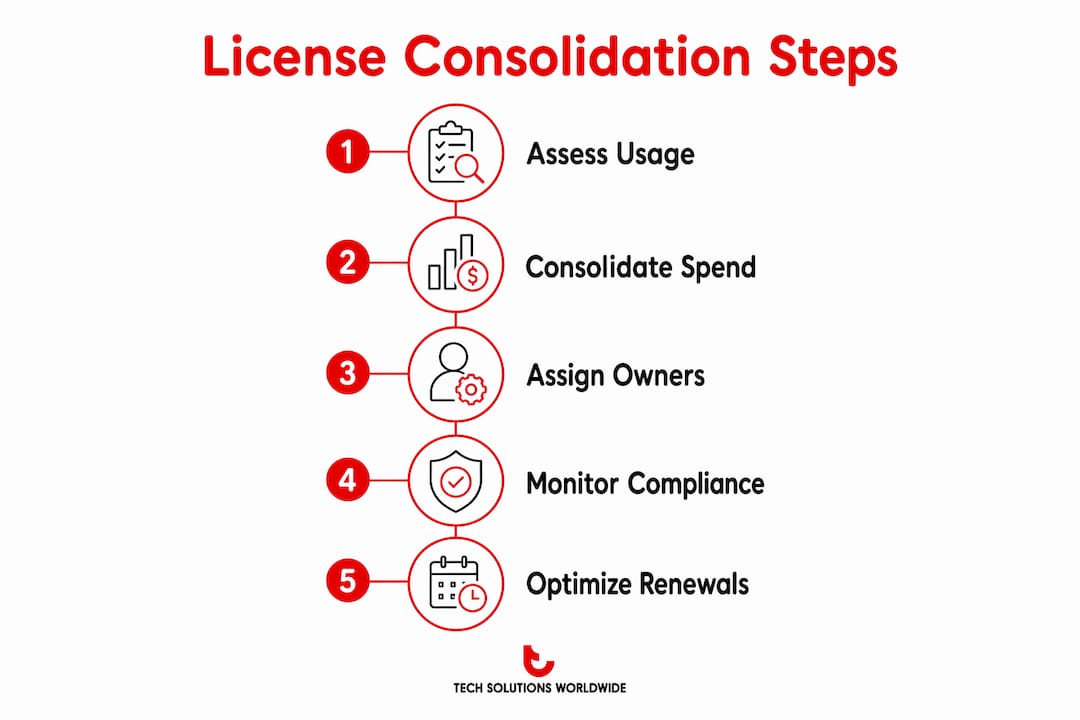
Start with spend consolidation. Spend consolidation yields immediate budget recovery, while administrative and integration savings build gradually. Identifying and eliminating redundant licenses in the first 90 days creates visible financial results that sustain organizational support for the broader project.
Assign accountable owners. ELA management requires continuous oversight, not periodic review. Assign a named owner responsible for utilization tracking, renewal management, and vendor communication. Without a designated owner, license waste accumulates between renewal cycles.
Structure the migration. Technology consolidation projects with structured user communication recover full productivity 40–50% faster post-consolidation. Communicate the timeline, the tools being retired, and the replacement workflow before the cutover date. Hence, users who understand the change adapt faster than those who encounter it without warning.
Additional practices that protect consolidation outcomes:
- Audit utilization before renewing. Pull usage reports 90 days before any renewal and use the data to right-size the agreement.
- Align contract dates. Stagger renewal dates create constant negotiation pressure. Align them to one or two annual windows.
- Monitor auto-renewal clauses. Calendar notification deadlines immediately after signing. Missing a 60-day or 90-day window locks the organization into another term.
- Track the Microsoft 365 tenant migration process if consolidating Microsoft licenses, as tenant structure directly affects entitlement assignment and user access during the transition.
Pro Tip: Use utilization data as a negotiation tool, not just a reporting metric. As a result, vendors respond to buyers who can demonstrate exactly how many seats are active and exactly how many are idle.
The comparison below shows how consolidation outcomes differ based on planning depth:
| Planning approach | Typical outcome |
|---|---|
| Ad hoc, contract-by-contract | Partial savings, high admin burden remains |
| Structured program with utilization data | 20–35% spend recovery within 12 months |
| Continuous management with assigned owner | Sustained savings and audit readiness |
Key Takeaways
Enterprise license consolidation delivers measurable cost recovery, reduced administrative burden, and sustained compliance when executed with utilization data, structured migration, and continuous ownership.
| Point | Details |
|---|---|
| Spend consolidation comes first | Eliminating redundant licenses delivers 40–50% of total consolidation savings fastest. |
| Utilization data drives negotiation | Entering ELA negotiations with usage metrics produces better terms and prevents seat overestimation. |
| Structured migration protects productivity | Organizations with planned user communication recover productivity 40–50% faster after consolidation. |
| Assign a named ELA owner | Continuous oversight prevents license waste from accumulating between renewal cycles. |
| Align renewal dates | Consolidating contract renewal windows reduces reactive procurement and improves negotiation leverage. |
Technology Solutions Worldwide’s view on what consolidation actually requires
Consolidation is not a procurement event. Hence, that is the most common misunderstanding Technology Solutions Worldwide encounters when working with IT leaders who have attempted it once and seen limited results.
The organizations that recover the most from consolidation treat it as an ongoing management discipline. Hence, They assign ownership, track utilization continuously, and use that data to negotiate every renewal. Additionally, the ones that treat it as a one-time contract restructuring find themselves back in the same position within two years, with a new layer of fragmentation added on top of the old one.
The legal dimension is consistently underweighted. Anti-assignment clauses, true-up terms, and auto-renewal windows are not boilerplate. They are the mechanisms that determine whether the financial model holds over the contract term. Most importantly, Technology Solutions Worldwide has seen organizations lose six figures in a single true-up because no one tracked utilization between signing and the anniversary date.
User adoption is the other factor that separates successful consolidation from failed ones. Consolidation projects that focus solely on cost-cutting without addressing user adoption face prolonged productivity declines that erode the financial case entirely. For instance, the financial savings are real. Sustaining them requires that users actually adopt the consolidated tools, which requires communication, training, and a clear answer to the question every user asks: “What happens to my workflow?”
Consolidation done well is not about cutting tools. It is about building a software portfolio that the organization can actually manage, audit, and afford over time.
— Technology Solutions Worldwide
Microsoft licensing support for enterprise consolidation
Technology Solutions Worldwide specializes in Microsoft licensing support for enterprises navigating complex consolidation projects. With over 20 years of experience and clients including Coca-Cola and T-Mobile, the firm provides structured guidance on ELA negotiation, volume licensing, and migration planning.
Organizations working with Technology Solutions Worldwide access competitive discounts of 20–30% off Microsoft subscriptions, along with dedicated support for license planning and compliance management. For instance, the firm’s Microsoft licenses and migration services cover the full consolidation lifecycle, from initial portfolio assessment through ongoing utilization tracking and renewal management. Hence, government agencies, mid-market firms, and global enterprises use these services to bring fragmented Microsoft environments under a single, manageable agreement.
FAQ
What is enterprise license consolidation?
Enterprise license consolidation is the process of replacing multiple separate software agreements with a single enterprise license agreement (ELA) that covers all products, users, and entitlements under one contract. Therefore, the goal is to reduce cost, simplify administration, and improve compliance visibility.
How much can consolidation reduce software spend?
Structured consolidation programs recover 20–35% of annual SaaS spend within 12 months, with 40–50% of those savings coming from eliminating redundant and underutilized licenses.
What is the biggest risk in an enterprise license agreement?
Overestimating user counts at signing is the most common risk. Up to 50% of licensed seats go unutilized in enterprise agreements, locking organizations into unnecessary spend for the full contract term.
How does consolidation improve compliance?
Consolidation creates a single source of truth for entitlements and usage data, which makes audit preparation faster and reduces the risk of true-up surprises at contract anniversary dates.
When should an enterprise start the consolidation process?
The best time to start is 90 days before any major software renewal. That window allows time to pull utilization data, identify redundant licenses, and enter negotiations with accurate seat counts rather than projections.
Recommended
- Enterprise License Agreement Explained for Decision-Makers
- Microsoft 365 Enterprise Bundle: What Organizations Need to Know
- Microsoft licenses and migration services
- Types of Microsoft Business Licenses: 2026 SMB Guide
VIEW THE DISCOUNTED MICROSOFT ENTERPRISE OPTIONS WITH TECHNOLOGY SOLUTIONS WORLDWIDE HERE.