
Enterprise licensing compliance is defined as the practice of ensuring an organization’s software usage conforms to the terms, quantities, and types specified in its license agreements. The role of enterprise licensing in compliance extends beyond contract management. It directly affects how organizations meet regulatory obligations under frameworks like GDPR, HIPAA, and PCI DSS, and how they control financial and legal exposure from software audits. Compliance officers and IT managers who treat licensing as a procurement task rather than a governance function consistently face audit risk, cost overruns, and regulatory gaps. Understanding the full scope of this function is the first step toward closing those gaps.
How does enterprise licensing compliance differ from regulatory compliance?
License compliance confirms an organization holds the correct license type and quantity for its actual software usage. Regulatory compliance ensures that the software and data handling practices within that organization meet legal and security standards. These are two distinct obligations, and failing either one creates separate but overlapping consequences.

License compliance is contractual. It governs whether you are using the right number of seats, the correct license type (named-user, concurrent, or processor-based), and whether usage stays within the permitted scope. Regulatory compliance is statutory. It governs how data is processed, stored, and protected under laws like GDPR in the European Union, HIPAA in healthcare, and PCI DSS in payment processing.
The two areas intersect when software handling practices affect data security. An unlicensed application running on a corporate network may lack vendor security patches, creating a HIPAA or PCI DSS exposure. ISO 19770 is the standardized framework for Software Asset Management processes that helps organizations maintain defensible compliance across both dimensions.
| Dimension | License compliance | Regulatory compliance |
|---|---|---|
| Governing authority | Software vendor contract | Government law or industry standard |
| Primary focus | License type, quantity, and permitted use | Data protection, privacy, and security |
| Key frameworks | ISO 19770, Enterprise Agreement terms | GDPR, HIPAA, PCI DSS |
| Failure consequence | Audit penalties, back-billing, legal action | Regulatory fines, data breach liability |
| Management owner | IT asset management, procurement | Legal, compliance, security teams |
Both functions require active governance. Organizations that manage them in silos create blind spots that auditors and regulators will find.
What are the common challenges and risks in managing enterprise licensing compliance?
Non-compliance with software licensing can result in penalties up to three times the license cost, operational disruption, and reputational damage. The average settlement cost for audit findings exceeds $150,000. These are not edge-case outcomes. They reflect the routine exposure that comes from poor license governance in medium to large enterprises.
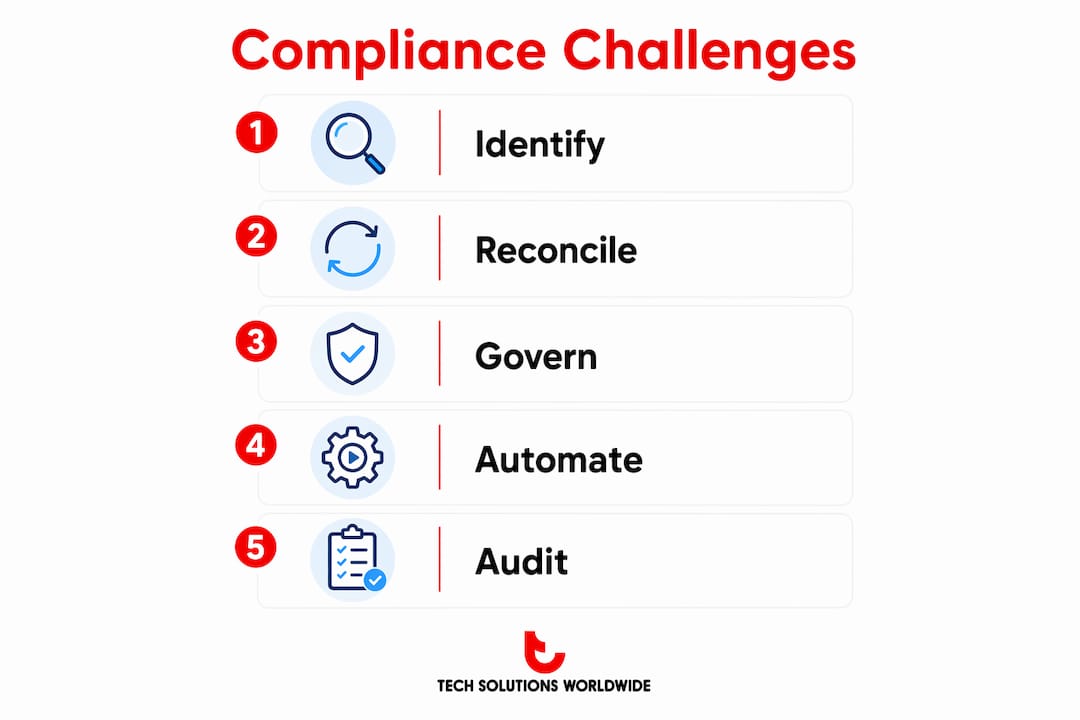
The core challenges fall into several categories:
- License type complexity. Concurrent, named-user, and processor-based licenses each carry different usage rules. Misapplying a license type is a common audit trigger.
- Inaccurate inventory. 37% of software installed in enterprises is unlicensed. Most organizations cannot account for all deployed software at any given time.
- Compliance drift. When employees change roles or leave the organization, their software assignments often remain active. This creates both a license overage and a security exposure.
- True-up clause exposure. Enterprise agreements typically include annual reconciliation clauses that bill retroactively for usage growth. Organizations that track licenses loosely face unexpected costs at true-up time.
- Disconnected systems. License data held in procurement systems that do not communicate with IT asset management or HR platforms creates gaps that compound over time.
Pro Tip: Run a quarterly license reconciliation against your HR system. Every terminated employee with an active software seat is both a wasted cost and a potential audit finding.
The importance of licensing governance becomes clear when you map these risks to actual audit scenarios. Vendors have the contractual right to audit usage at any time, and the burden of proof falls on the organization to demonstrate compliance.
How can integrating enterprise licensing with identity and access management improve compliance?
License governance integrated into IAM and IGA lifecycles is the most effective method for reducing compliance drift in enterprise environments. Identity and Access Management (IAM) controls who has access to which systems. Identity Governance and Administration (IGA) manages the lifecycle of those access rights. Connecting license assignments to both processes closes the gap that causes most compliance failures.
The practical mechanism is automatic deprovisioning. When a user’s role changes or their employment ends, an IAM-integrated license governance system revokes the software assignment at the same time as the access credential. In other words, without this connection, licenses accumulate on inactive accounts. Moreover, those accounts then appear in vendor audits as active usage, triggering back-billing and potential regulatory exposure if the accounts retain access to sensitive data.
Software licensing is a governance issue, not just a procurement label. License types impose different compliance burdens. Similarly, a processor-based license tied to a decommissioned server that still appears in the license inventory is both a cost problem and a governance failure. Subsequently, lifecycle review of software assignments and renewals must align with IAM and IGA processes to reduce waste and compliance drift.
Practical integration approaches include:
- Connecting your Software Asset Management (SAM) platform to your HR system so that terminations trigger automatic license reviews.
- Building license assignment rules into your IGA workflows so that role changes automatically adjust software entitlements.
- Scheduling periodic access certification campaigns that include license validation alongside access rights reviews.
Pro Tip: Treat every license assignment as an entitlement, not a purchase. Entitlements have owners, expiration conditions, and review cycles. Purchases do not.
Microsoft licenses and migration services that align with IAM processes give compliance officers a single point of control for both access governance and license accountability.
What is the enterprise subscription true-up process and how does it affect compliance?
The enterprise subscription true-up is an annual or periodic reconciliation process in which an organization reports its actual software usage to the vendor and pays for any increases above the originally contracted quantity. Microsoft Enterprise Agreement true-ups are the most common example in large enterprises. Above all, additions are billed retroactively at the negotiated EA rate, covering the full period since the last reconciliation.
The compliance implications of the true-up process are significant. Organizations have a legal obligation to report usage accurately. Additionally, under-reporting is a contract breach that vendors can pursue through audit rights. Over-reporting wastes budget. On the other hand, the goal is accurate reporting, which requires reliable license tracking throughout the year, not just at reconciliation time.
“True-up clauses are legitimate commercial mechanisms but become costly when buyers accept quarterly cycles, overage at list price, and lack true-down rights.” — SaaS true-up analysis
True-Up
The true-up asymmetry is a structural contract risk. Vendors can charge for growth during the agreement period, but most standard contracts do not grant the buyer the right to reduce license counts if usage declines. Moreover, this means organizations pay for licenses they no longer need unless they negotiate bilateral true-down rights at contract signing.
Best practices for managing the true-up process:
- Track usage continuously. Do not wait for the annual reconciliation to discover overages. Monthly license reports against actual deployment data prevent surprises.
- Negotiate true-down rights. Demand the explicit right to reduce license quantities at renewal. This is a standard negotiation point that many organizations fail to raise.
- Define user metrics clearly. Confirm how the vendor defines an active user, a named user, and a concurrent user before the agreement is signed. Ambiguous definitions become expensive at true-up time.
- Align true-up timing with budget cycles. Annual true-ups that fall in the middle of a fiscal year create budget pressure. Negotiate timing to align with your financial planning calendar.
- Document all usage changes. Maintain an audit trail of license additions, removals, and role changes throughout the year. This documentation is your defense in any vendor audit.
Key takeaways
Enterprise licensing compliance requires lifecycle integration with identity governance, accurate true-up tracking, and clear separation from regulatory compliance obligations to reduce audit risk and financial exposure.
| Point | Details |
|---|---|
| License vs. regulatory compliance | License compliance is contractual; regulatory compliance is statutory. Both require active governance. |
| Compliance drift risk | Disconnecting license management from IAM and IGA lifecycles is the primary cause of compliance drift and audit exposure. |
| True-up accuracy | Accurate annual true-up reporting requires continuous license tracking, not a once-a-year count. |
| True-down negotiation | Negotiating bilateral true-down rights at contract signing prevents overpaying for unused licenses after workforce reductions. |
| ISO 19770 framework | ISO 19770 provides the standardized process framework for defensible Software Asset Management compliance. |
The convergence of licensing and identity governance is no longer optional
Technology Solutions Worldwide has worked with organizations across government, healthcare, and enterprise sectors for over 20 years. Most importantly, the pattern that creates the most compliance risk is consistent: license management sits in procurement, identity management sits in IT security, and neither team talks to the other until an audit forces the conversation.
The organizations that handle this well do not treat licensing as a cost center problem. Hence, they treat it as a governance function with the same lifecycle controls applied to user access. When an employee is terminated, the license is revoked at the same time as the network credential. When a role changes, the software entitlement changes with it. This is not a technology problem. It is an organizational design problem that technology can solve once the right processes are in place.
The true-up process is where this gap becomes financially visible. Organizations that track licenses loosely all year face reconciliation surprises that could have been avoided with monthly reporting. Hence, the negotiation side matters equally. Most organizations sign Enterprise Agreements without demanding true-down rights, then pay for licenses they no longer need after a restructuring or a cloud migration.
The compliance officers and IT managers who get this right share one characteristic: they treat every software license as an entitlement with an owner, a review cycle, and an expiration condition. Additionally, that framing changes how the entire organization manages software governance.
— Technology Solutions Worldwide
Microsoft licensing support from Technology Solutions Worldwide
Technology Solutions Worldwide provides Microsoft licensing support and subscription management services for medium to large enterprises managing complex compliance obligations. Services cover Microsoft Enterprise Agreement structuring, true-up preparation, and license lifecycle alignment with identity governance processes.
In conclusion, Technology Solutions Worldwide offers 20–30% discounts off standard Microsoft subscription pricing, with direct support for compliance officers and IT managers navigating annual true-up cycles. The firm’s volume licensing guidance addresses both cost control and audit readiness, drawing on over 20 years of experience with clients including government agencies and major corporations. Therefore, contact Technology Solutions Worldwide to review your current Microsoft licensing position and identify compliance gaps before your next true-up date.
FAQ
What is the role of enterprise licensing in compliance?
Enterprise licensing compliance confirms that an organization’s software usage matches the terms, types, and quantities in its license agreements. It reduces audit exposure, supports regulatory compliance, and controls financial risk from vendor reconciliation processes.
What is an enterprise subscription true-up?
An enterprise subscription true-up is an annual reconciliation where an organization reports actual software usage to the vendor and pays for any increases above the contracted quantity. Microsoft Enterprise Agreement true-ups bill additions retroactively at the negotiated EA rate.
How does licensing affect regulatory compliance like GDPR or HIPAA?
Unlicensed software often lacks vendor security patches, creating direct exposure under data protection regulations. License compliance and regulatory compliance overlap wherever software handles personal or sensitive data.
What is a true-down right and why does it matter?
A true-down right is a contractual provision that allows an organization to reduce its license count at renewal if usage has declined. Negotiating true-down clauses prevents organizations from paying for unused licenses after workforce reductions or system consolidations.
What framework governs software asset management compliance?
ISO 19770 is the recognized international standard for Software Asset Management. It provides the process framework organizations use to maintain defensible license compliance and prepare for vendor audits.
Recommended
- Microsoft licenses and migration services
- Need Of Volume Licensing
- Do you need a license to use Microsoft Office on Windows? – Technology Solutions
- Microsoft Licensing Help | Techsolworld
VIEW A FULL LISTING OF MICROSOFT GOVERNMENT LICENSES AND PURCHASE THEM HERE.